

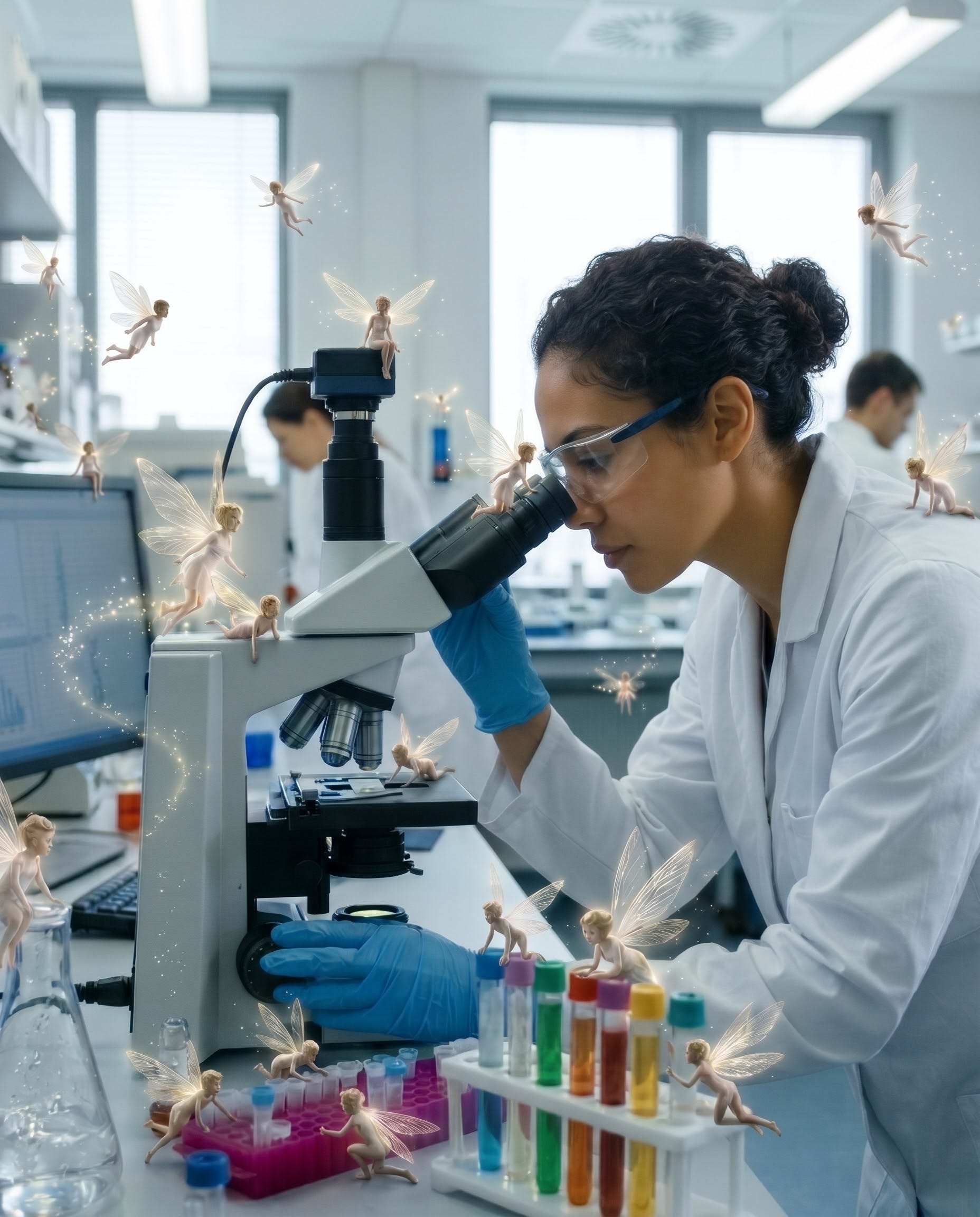
Do fairies exist? ✨
You might expect the scientific answer to be a flat “no.” After all, that’s what we’ve been told science says. But what if the truth is not quite as simple?
I am a scientist.
At least, that is what my degrees, research papers, and professional experiences indicate.
But over the years, I’ve found myself asking a different question:
What does being a scientist really mean?
Most of us hear the word “science” and think of a familiar collection of subjects: physics, chemistry, biology, mathematics. If we think a bit longer, we might add the social sciences to the mix too, along with the hogger of almost all attention in the world today: computer science and artificial intelligence. Scientists are therefore viewed as an elite guild of experts, specializing in one of these rigorous disciplines, who understand the universe better than everyone else.
Or maybe that’s just how we, scientists, like to think of ourselves.
The rest of the world might be growing a bit tired of our arrogance. Of the smirk and crinkled nose with which too many of us dismiss what the general public brings to the table—the public we are meant to serve—as if we’ve never been wrong ourselves; as if we haven’t run a thousand failed experiments for every successful one; as if any scientific breakthrough ever came from someone who dared not dream of fairies.
So, what does science truly say about fairies? It says nothing, and asks instead a thousand questions:
Have you designed a research study to investigate this possibility?
What type of study was it, and what did it find?
Did it have enough statistical power — meaning if fairies were genuinely out there, was your study sensitive enough to detect them? Or did you scan one backyard for ten seconds with a blurry camera and declare the whole planet empty?
Was there any bias involved? For instance, did every report of fairies come from those who were raised to believe in them?
Were there any confounding variables? If every sighting came from people who had been drinking, for example, alcohol could be a confounding variable.
Were there any other known limitations?
To establish the existence of anything — or to reasonably rule it out — science requires empirical evidence.
Suppose I say fairies don’t exist because I’ve never seen one. That is meaningless evidence. I have never seen most deep-sea creatures or observed another galaxy with my own eyes. My inability to see something is not proof of its absence.
Even if we survey 100,000 people all across the world and find zero credible sightings, does that still prove fairies definitively don’t exist? No. Perhaps they live somewhere beyond the Earth. Perhaps human eyes simply lack the spectrum to perceive them. Or perhaps they simply aren’t real.
Given the absence of reliable evidence, it is completely rational to live as though fairies reside only in folklore and fantasy. Science doesn’t ask us to treat every possibility as equally likely. It simply asks us to match our confidence to the evidence. A well-designed study can make a specific claim exceedingly unlikely—even if no single study can rule out every imaginable version of it.
At the same time, science also demands that we stop confusing unlikely with impossible, and continue to remain open to new evidence without abandoning our standards for evaluating it. History itself is defined by these exact moments: the entire world changing its mind as our findings finally catch up with the unseen. Below are just a few examples:
What causes vision: For over a thousand years, thinkers from Euclid to Ptolemy insisted that vision came from rays emitted by our eyes, reaching out to touch the objects we see. A few, like Aristotle, had suspected the opposite, but no one could settle it. In eleventh-century Cairo, Ibn al-Haytham, who is regarded by many as one of the founders of the scientific method itself, finally did. Using carefully designed experiments involving dark chambers and pinhole beams, he demonstrated that vision occurred when light enters the eye. Light had always been entering our eyes—it just took us over a millennium to prove it.
Can washing hands save lives: In the mid-1800s, doctors believed illnesses were caused by “miasma”— foul odors in the air—or internal imbalances in patients. When Ignaz Semmelweis showed that washing hands in a chlorine solution saved lives, dramatically reducing maternal mortality in a hospital, his peers mocked him for suggesting that their own hands carried death. It took decades, and the rise of germ theory, before the case became overwhelming. Today, hand hygiene is one of the most fundamental practices in medicine, saving countless lives. And the automatic impulse to reject evidence that contradicts our established beliefs now has a name: the “Semmelweis reflex.” Germs have always existed. What changed was our ability, and our willingness, to see that they do.
Do ancient texts hold the secrets for modern medicine: In the late 1960s, as malaria grew resistant to existing drugs, Tu Youyou turned to ancient Chinese medical texts to find a solution. Inspired by a 1,600-year-old reference to sweet wormwood soaked in cold water, she refined its extraction through rigorous experimentation and isolated artemisinin—now the foundation of the world’s most effective antimalarial therapies. Nature had held the answer for centuries. We simply lacked the tools to recognize it earlier.
To be fair, for every Semmelweis, history also holds plenty of confident dissenters who were simply wrong. Being doubted doesn’t make anyone right. Evidence does.
Still, again and again, science reminds us that reality is often stranger, richer, and more beautiful than the simple models we first build to understand it.
Newton’s physics served as the dominant framework for two centuries — until Einstein revealed that the universe is not a static stage but rather a living fabric where time can stretch, space can bend, and gravity becomes geometry. Today, physicists continue to uncover even deeper mysteries, suggesting that the truth might surpass our wildest imagination.
Science is a deeply humbling process, because the more we know, the more we discover how much remains unknown. Every experiment has limitations. Every dataset contains gaps. Every human observer carries their own set of biases and assumptions. And if we look to the cosmos—all the ordinary matter we understand today, every star, planet, and atom—accounts for less than 5% of the universe.
This is not to say that science gives us no answers. Gravity, the Earth’s orbit around the Sun, the existence of atoms, evolution by natural selection — all are extraordinarily well-supported by centuries of independent observations.
Scientific expertise represents years — often decades — of careful observation, experimentation, and learning from those who came before. That accumulated knowledge deserves our respect and our gratitude.
You are more likely to receive an accurate medical diagnosis from a trained physician than from a Reddit commenter. And if you want to understand climate change, climatologists will probably give you a more reliable picture than a social media influencer.
In fact, the very screen you are reading this on exists only because generations of researchers remained committed to expanding the boundaries of human knowledge.
Yet true expertise never closes the door on curiosity. The greatest breakthroughs in history did not come from scientists who mocked the unknown, but from those who had the humility to say, “I don’t know—let’s test it.”
Science offers the best provisional explanation supported by today’s evidence, with a standing promise to rewrite the book tomorrow if better data shows up. And it continues to progress and surprise us even amidst our fragile egos and inherent biases, because the evidence can outlive us all.
Every scientific breakthrough begins with the same quiet act: someone notices something that others overlooked. An apple falling. Pond water under a lens. A crop that grew differently.
Science begins not with certainty. It begins with wonder. And it survives only through courage and humility.
Imagine living your life with the same scientific mindset, which organizational psychologist Adam Grant identifies as a distinct mode of thinking in his book Think Again. Imagine entering an argument and asking not, “How do I prove that I’m right?” but:
What evidence supports my view?
What evidence would change my mind?
What am I assuming, and what might I be missing?
Perhaps being a scientist is less about knowing all the right answers, and more about asking the right questions while remaining open to the possibility of being wrong.
Science is more than a body of knowledge. It is a way of seeing. A promise we make to ourselves:
To remain curious.
To observe carefully.
To test our assumptions.
To value and respect expertise without surrendering our own critical judgment.
To follow evidence more faithfully than our ego.
And to change our minds when the evidence asks us to.
That is the scientific spirit, and precisely what makes science one of humanity’s most beautiful inventions. It reminds us that evolving our views is not intellectual weakness. Sometimes, it is the strongest evidence of our internal growth.
So, do fairies exist?
Honestly, I don’t know. I’ve never seen one, and have no reason to expect I will. But I do hope to someday shed the jaded self in me who smirks at this question, and recognize instead that the child asking it is doing exactly what every great scientist once did: standing at the edge of what we know, and wondering what lives just beyond it.
And perhaps we can help those within our circle of influence remember to practice the science of wonder again.
One question. One experiment. One wondering mind at a time. Starting with ourselves.
So, are you ready to awaken the scientist within?
Happy Sunday 🙂
🪽From my wings to yours — may we never stop flying.