

“Magic is unexplained science.”
This is an oft-quoted definition of magic, rooted in Arthur C. Clarke’s famous Third Law:
“Any sufficiently advanced technology is indistinguishable from magic.”
This statement, of course, is difficult to dispute. To any medieval observer, the everyday modern conveniences we tend to take for granted would appear as potent sorcery: airplanes defying gravity, pocket-sized screens transmitting voices across oceans, and small white tablets banishing physical pain within an hour. And if we continue to follow this historical trajectory, everything that we still perceive as mystical today might simply transform into demystified science taught in grade-school classrooms tomorrow, much like the water cycle, light refraction theory, and electromagnetism.
So, yes: magic might well be unexplained science. But is that all it is?
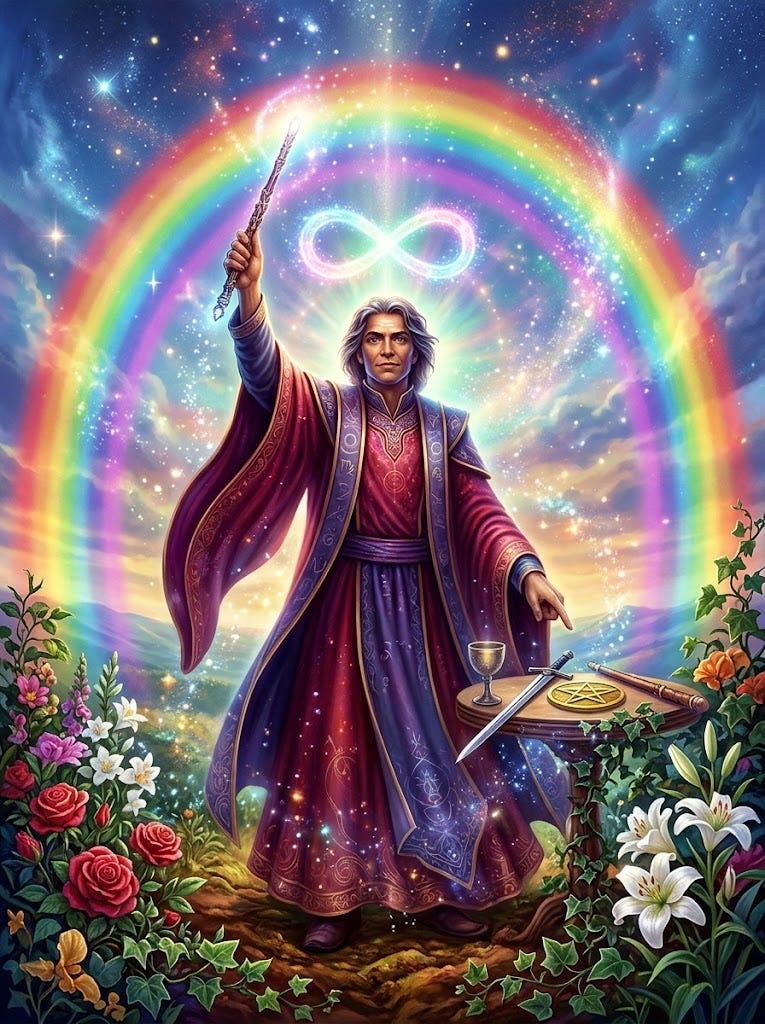
In tarot—a centuries-old symbolic language that has served seekers as both mirror and compass—the first numbered card of the 78-card Rider–Waite–Smith deck is called “The Magician”. With one hand raising a wand toward the heavens and the other pointing down to the earth, the Magician, with an infinity symbol over his head, demonstrates the timeless act of bringing the intangible down into matter: alchemizing divine inspiration into reality through grounded action.
And isn’t that precisely how every scientific invention is made? Because before an invention enters physical reality, it lives exclusively in the collective spheres of creativity and imagination. And what is creativity, if not divine inspiration?
Long before the modern submarine explored the ocean floor, it existed as a wonderful concept in Jules Verne’s Twenty Thousand Leagues Under the Sea. Simon Lake, one of the pioneers who brought the modern submarine to life, credited Verne’s novel with setting the course of his life’s work. Materializing the vessel into physical existence never drained the story of its magic. If anything, the magic of imagination was the indispensable blueprint guiding its creation.
History offers countless examples where breakthrough ideas appeared not through deliberate analysis alone, but through dreams, intuition, or moments when the conscious mind had stepped aside. Dmitri Mendeleev reportedly saw the periodic table complete in a dream. Srinivasa Ramanujan credited many of his extraordinary mathematical insights to dreams in which the Hindu goddess Namagiri Thayar revealed them to him. August Kekulé famously described drifting into a half-asleep reverie by the fire and seeing a snake seize its own tail—an ouroboros—inspiring the ring structure of benzene. Otto Loewi dreamed up the experiment that proved nerve cells communicate chemically.
And it was not only in sleep that such visions arrived: Albert Einstein imagined himself riding alongside a beam of light long before the mathematics of relativity emerged, and Nikola Tesla described mentally constructing and testing entire machines before ever building them physically.
So, while magic might be called unexplained science, science is so often the child of magic: the fruit of an intuitive leap nourished by logic and patient labor—the Magician’s lowered hand preparing the vessel for what the raised wand would call down.
Perhaps someday we will discover a simple scientific explanation for the seemingly miraculous powers of dreams and intuition. But what happens once the explanation arrives? Does the magic truly evaporate?
I don’t think so.
The water cycle might explain why rain arrives, but it cannot dissolve the enchanting feeling of dancing in summer rain. The poet John Keats once lamented that Newton had “destroyed the poetry of the rainbow by reducing it to the prismatic colors”; yet two centuries later, we are still left speechless by its beauty. And when you listen to your favorite singer’s voice effortlessly hitting the notes of your favorite song, you are not looking for an acoustic equation for what makes their timbre resonate. You are simply immersed in the here and now, experiencing magic.
The legendary singer Mohammed Rafi is reported to have said that it was never he who wielded the magic of his voice, but rather the Divine willing it into being.
Science might hand us the mechanism behind it all, but what it can never do is replace the experience of encountering Divinity.
In that sense, every scientist, artist, writer, musician, sorcerer—every human—is practicing the same alchemy: reaching into the unseen, translating it into form, and reminding us to look at the world with eyes full of wonder.
And so, what is magic then?
Tell me: what stirs in you that quiet, inexplicable sense of boundless awe that makes life worth living?
That’s magic.
🪽From my wings to yours—may we never stop flying